


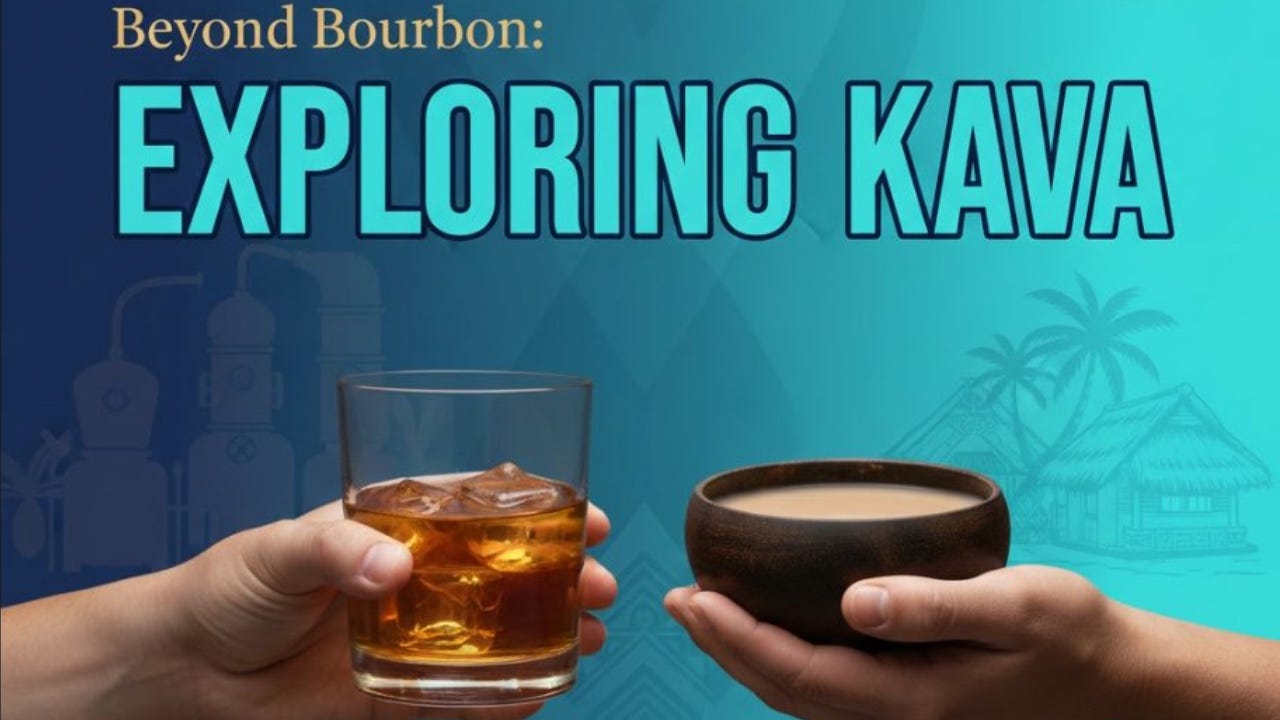
When prescription anxiety meds leave you blank for hours, where do you turn? Morgan Smith found his answer in a plant that’s been consumed safely for thousands of years.
This week on EmbellishPod, we venture beyond bourbon to explore kava culture, sustainability, and the growing movement toward alcohol alternatives.
The Moment Everything Changed
Picture this: You’re a software developer working in the high-stakes world of payments and finance. One minute of system downtime equals millions in losses. You’ve just had your second child. The pressure mounts. Your doctor prescribes an SSRI and benzodiazepines for panic attacks.
Then you take one at work.
“I don’t remember what I did the rest of the day,” Morgan Smith tells me during our conversation. “I came to a couple hours later at night and thought, whoa, what happened? It turns out I was driving coworkers to lunch, doing all sorts of work, and I thought—what’s going to happen if my newborn son needs to go to the hospital and I’m out of my mind on this stuff?”
That terrifying realization sent Morgan on a journey that would eventually lead him from tech cubicles to kava farms in Hawaii and throughout the South Pacific.
What Actually Is Kava?
Before we go further into Morgan’s story, let’s address the obvious question: what the hell is kava?
Kava (Piper methysticum) is a plant native to the Pacific Islands that’s been consumed ceremonially and socially for over 3,000 years across Polynesia, Melanesia, and Micronesia. The active compounds, called kavalactones, produce a calming, mildly euphoric effect without the cognitive impairment of alcohol or the blanking effects of benzodiazepines.
“It’s just like coffee for the afternoon,” Morgan explains. “It’s normal. It’s safe. It’s something that’s not going to hurt you and it’s not going to cause long-term problems.”
Unlike alcohol, kava doesn’t impair judgment or motor skills. You won’t wake up with a hangover. And there’s no addictive potential like prescription anxiety medications.
From England to the Tropics
Morgan’s background couldn’t be further from Pacific Island culture. “I’m big into ancestry,” he shares. “Most of my family is from England, Scotland, Ireland, and a little bit of Germany. And I always think—kava is one of those things that people are drawn to because they’re trying to get away from alcohol.”
He pauses before adding with a laugh, “My past family’s generations were probably creating a bunch of whiskey, and that ended up maybe not helping some people. And kava hopefully will kind of reverse some of that. I have a family history of alcoholism, so I was very concerned about that growing up.”
This personal connection to the downsides of alcohol, combined with his own struggles finding appropriate anxiety relief, made kava a revelation when he discovered it over a decade ago.
Building KALM with Kava
Today, Morgan owns and operates KALM with Kava (Kalm with a K), one of the nation’s largest kava distributors. The company imports kava from Tonga, Samoa, Fiji, and Vanuatu, while also farming it on Hawaii’s Big Island alongside sugarcane and taro.
The business was originally started about 15 years ago by Morgan’s friend Mike, whose legacy still drives the company’s vision. “I have a picture of him at the office on my back wall and I think about him all the time,” Morgan shares. “I was reading his text messages from 2018 a couple months ago, kind of looking back and thinking, ‘what would Mike do in this situation?’”
Mike’s plans for the farm—shared in a 2018 text message—are now Morgan’s roadmap for 2026-2028. “I’m taking what he actually said and I’m doing it. The plants he first started growing in Hawaii have tons of progeny now, and soon people will be able to enjoy all of his work.”
Magic Mushroom Rum (No, Really)
One of KALM’s more intriguing products is their Magic Mushroom Rum—which, despite the name, contains neither magic mushrooms nor rum. It’s a kava-based beverage that delivers the plant’s traditional effects in a modern, accessible format.
The naming reflects the creative approach many kava companies are taking to make the botanical more approachable to American consumers who might be intimidated by traditional preparation methods (which involve mixing the powdered root with water in what Morgan calls “muddy, root-flavored nastiness”).
The Sustainability Challenge
Our conversation takes a serious turn when discussing the kava industry’s biggest challenge: supply chain sustainability.
“People are drinking kava today that was planted three to four years ago,” Morgan explains. “It takes that long to grow. So if we don’t plant today, in three or four years there’s not going to be any kava to drink. And unfortunately, a lot of kava farmers out there are not thinking about that.”
The issue is particularly acute in the South Pacific, where educational access and long-term planning resources may be limited. “What I’d like to see is investment into the kava space where people really understand what happens when you don’t plant,” Morgan emphasizes. “These communities throughout the South Pacific depend on this.”
Testing, Transparency, and Trust
As kava gains popularity in the United States, Morgan is adamant about one thing: testing and transparency.
“I’d like to see kava companies really showing their lab tests saying, ‘this is what we test for and this is how we test it,’” he states. “Kava is an herb grown in the middle of the South Pacific. We need to make sure that whatever we’re putting into our bodies isn’t going to hurt us. We have to test for things like E. coli and salmonella.”
I couldn’t help but add my two cents here: “If you are a kava producer, get the test and publish them now, because all it requires is a handful of bad reactions in the United States to create an infrastructure that requires you. If you do the work on the front end, maybe they don’t ever require you to do it because you’re already doing it.”
The alternative—waiting for federal regulation after problems arise—would be far more burdensome than voluntary testing now.
Why This Matters for Spirits Culture
You might be wondering why a bourbon and whiskey podcast is covering kava. The answer is simple: the spirits world isn’t about gatekeeping or narrow definitions. It’s about understanding what people consume, why they consume it, and how culture shapes those choices.
The rise of kava, THC beverages, and other alcohol alternatives doesn’t represent a rejection of spirits culture—it represents an evolution. Younger generations are approaching consumption more intentionally, whether that means choosing craft cocktails over cheap beer, exploring non-alcoholic options, or seeking botanical alternatives that fit their lifestyle.
“I think people are being more intentional,” I noted during our conversation. “The volume isn’t there like it used to be. When people do want to consume alcohol, it’s usually through cocktail culture or through high-end spirits. It’s more like, ‘I want to actually enjoy what I’m consuming and the time that I am consuming it.’”
Kava fits into this broader trend of mindful consumption.
Finding Your Alternative
Morgan’s journey from tech burnout to kava farming demonstrates something important: there isn’t one right path for everyone. Whether you’re doing Dry January, reassessing your relationship with alcohol, or simply curious about what else is out there—having options matters.
“If you’re thinking about finding something just to help you wind down at the end of the day, kava could be it,” Morgan offers. “If not, that’s fine too. Let’s just be friends. Let’s connect. Let’s hang out.”
That’s the spirit (pun intended) that makes this conversation valuable. No dogma. No judgment. Just authentic exploration of what works for different people.
Listen to the full episode on your favorite podcast platform or watch on YouTube. Find KALM with Kava on Instagram, TikTok, and Facebook @kalmwithkava.
Pinkies down, fun up.
Want more spirits content, industry interviews, and cocktail culture exploration? Subscribe to EmbellishPod on your podcast platform of choice, follow us on Instagram and TikTok @embellishpod, and visit www.embellishpod.com for articles, episode details, and more.


