
Vieux Carré: A Cocktail Reconsidered
Eight Cocktails. Three Sessions. One Recipe Worth Making.

Hotel Monteleone • New Orleans • 1938
The final recipe is called The Carousel.
There’s a version of this article where I just give you the recipe. You’d make a solid Vieux Carré, enjoy it, move on. But that version leaves out the part where my wife told me it tasted like black licorice and I had to go back to the drawing board. It leaves out the budget vermouth that made everything feel vaguely incomplete, like a sentence that trails off. And it skips the moment I figured out why Dale DeGroff’s pimento bitters were the right solution to a problem I didn’t fully understand yet.
So we’re doing this the other way. The recipe is at the end. The story is worth reading first.
What You’re Actually Drinking
The Vieux Carré was created in 1938 by Walter Bergeron, head bartender at the Hotel Monteleone’s Swan Room in New Orleans’ French Quarter. ‘Vieux Carré’ is French for ‘Old Square’ — the French Quarter’s original name, back when the French actually ran the city.
Bergeron designed it as a tribute. The French Quarter in 1938 was genuinely multicultural in the way that tends to get romanticized in retrospect but was apparently just true: Americans, French, Italians, Caribbean communities all living in proximity. He built those communities into the glass.
• Rye whiskey = the Americans
• Cognac & Bénédictine = the French
• Sweet vermouth = the Italians
• Bitters = Caribbean influence
It’s a Manhattan that went to finishing school in Paris. Spirit-forward, complex, but not muddled. The IBA classifies it as an ‘Unforgettable’ — their designation for classic cocktails that aren’t as well-known as they should be. They’re right about that.
It first appeared in print in Stanley Clisby Arthur’s 1937 book Famous New Orleans Drinks and How to Mix ‘Em — which, yes, predates the 1938 Hotel Monteleone origin story by a year. History is messy. The drink exists. That’s what matters.
The Licorice Problem
Traditional Vieux Carré recipes call for equal dashes of Peychaud’s and Angostura bitters. This makes sense historically — Peychaud’s is a New Orleans institution, practically the official bitters of the French Quarter. It also contains anise, which gives it that distinctive licorice note.
Two dashes of Peychaud’s isn’t a lot. But in this particular combination of spirits, it was enough to flatten everything else. My wife tried the first test version and said it tasted like black licorice. She wasn’t wrong. The anise was punching above its weight and pulling the drink in a direction that Bergeron probably didn’t intend.
The solution took a while to find because I kept trying to reduce Peychaud’s rather than replace part of it. One dash instead of two helped but didn’t solve it. The flavor profile I wanted — Caribbean warmth that honored Bergeron’s tribute without introducing a licorice thread — needed something else.
Dale DeGroff’s Pimento Aromatic Bitters turned out to be exactly right. Pimento here means allspice, not the pepper — warm, Caribbean-inflected, no licorice. Two dashes of those, two dashes of Angostura for backbone, one dash of Peychaud’s to maintain the NOLA character without letting it dominate. The math worked. More importantly, the flavor worked.
The bitters blend actually connects more directly to Bergeron’s intent than the traditional version does. Pimento bitters are the Caribbean community in the glass, explicitly. It’s honoring the tribute more accurately while also tasting better. That doesn’t always happen.
The Sweetness Problem (and How Vermouth Fixed It)
Here’s the thing about vermouth: there’s a full ounce of it in this drink. Not a modifier amount, not a half-measure. An ounce. It’s not in the background — it’s structural.
I ran early tests with a mid-tier sweet vermouth. Not the cheapest option, but not premium either. The results tasted fine in isolation and incomplete as a cocktail. Something was missing, and I couldn’t isolate what it was by adjusting other variables. The drink wouldn’t cohere.
Switched to Carpano Antica Formula and immediately understood what ‘incomplete’ had been pointing at. Carpano is richer, more velvety, with pronounced vanilla notes that complement cognac’s oak in a way that lighter vermouths don’t. At 16.5% ABV, it has the body to hold up against the rye and the cognac. The Cocchi Vermouth di Torino — which legitimately won a PUNCH blind tasting competition in 2021 — was also excellent but read a little thin against this particular spirit combination. Carpano made everything feel settled.
Vermouth quality is non-negotiable here. That’s not a gatekeeping statement, just the practical reality of what the cocktail requires. Also: refrigerate it after opening, use it within two to three months. Old vermouth is the reason a lot of otherwise good Vieux Carrés taste like wine-adjacent disappointments.
How I Actually Tested This
Three sessions, eight total cocktails, roughly two weeks of development. I tested variables in isolation: cognac selection first, then rye, then vermouth. Testing spirits before vermouth matters because the vermouth needs to complement the spirits you’ve chosen, not the other way around. If you lock in vermouth first and then discover your rye doesn’t work with it, you’ve built the house on the wrong foundation.
Session 1: Cognac
Martell VS vs Pierre Ferrand 1840. This one wasn’t close. The Ferrand 1840 was developed with cocktail historian David Wondrich using 19th-century techniques — it’s literally designed for historic cocktails. Drier, more structured, better fruit-to-oak balance. The Martell was fine but added sweetness the drink didn’t need. My wife’s preference aligned with mine: Ferrand by a comfortable margin.
Session 2: Rye
Four candidates: Michter’s Barrel Strength, Rare Character Hurstknoll, Sazerac, and MB Roland.
Michter’s Barrel Strength won the taste test. Around 110 proof, intense complexity, handled everything you throw at it. The problem is that it’s also the most expensive option and its intensity makes it better suited for occasions when you want maximum impact rather than regular making. It’s the premium version.
Rare Character Hurstknoll Rye — a craft Kentucky selection — delivered 99% of the Michter’s experience at a more sensible price point for regular use. It stood up to the cognac without dominating it, integrated with the Carpano cleanly, and didn’t have that slightly precarious quality that sometimes comes with barrel-strength pours in stirred drinks.
Sazerac was a respectable third. Good NOLA connection given the cocktail’s origins. MB Roland didn’t work — the flavor profile pulled against the other ingredients rather than integrating.
Session 3: Vermouth
Cocchi Vermouth di Torino vs Carpano Antica Formula. As covered above, Carpano won. Both are legitimately good vermouths. In this specific combination, Carpano had the body and vanilla notes to pull everything together. Cocchi would be a solid choice in a different build.
The Vieux Carré Build — The Carousel
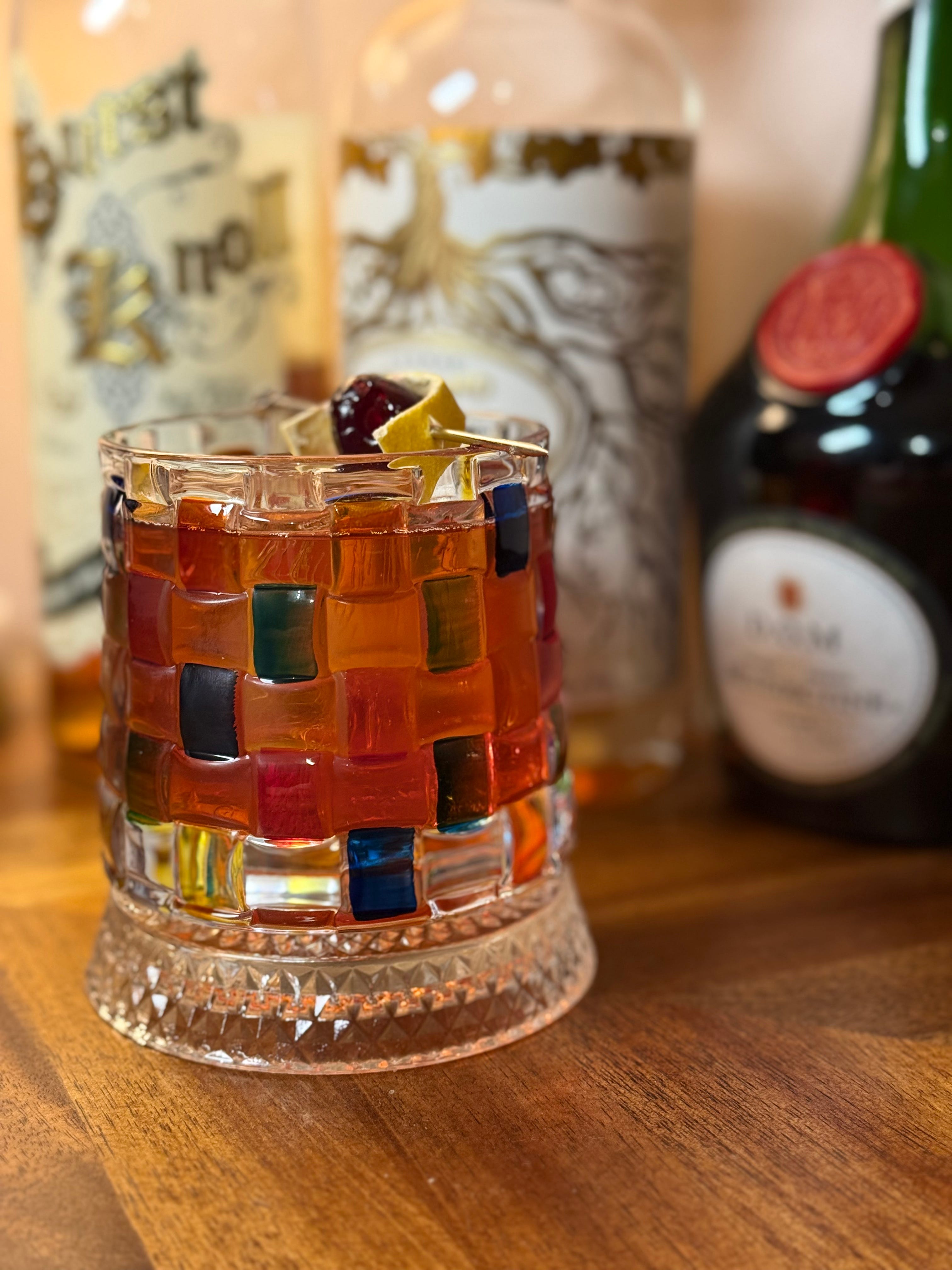
Walter Bergeron built his Vieux Carré at the Hotel Monteleone’s Swan Room, which has since been replaced by the Carousel Bar — a slowly rotating circular bar that’s become one of the more absurd and beloved things in New Orleans. Seemed like the right name for a Vieux Carré that keeps coming back around: same bones, refined by testing.
This is the standard version. The premium version swaps Hurstknoll for Michter’s Barrel Strength; everything else stays the same.
Amount
Ingredient
Notes
1 oz
Rare Character Hurstknoll Rye
Premium swap: Michter’s Barrel Strength
1 oz
Pierre Ferrand 1840 Cognac
Purpose-built for classic cocktails
¾ oz
Carpano Antica Formula
Refrigerate, use within 3 months
¼ oz
Bénédictine D.O.M.
Not negotiable; not B&B
2 dashes
Dale DeGroff’s Pimento Bitters
Caribbean warmth, no licorice
2 dashes
Angostura Bitters
Classic backbone
1 dash
Peychaud’s Bitters
NOLA authenticity, used sparingly
Lemon twist + Luxardo cherry
Garnish
Express twist; cherry optional
Construction
1. Add all ingredients to a mixing glass with ice.
2. Stir for 30 seconds. This drink needs the dilution. Under-stirred tastes hot; over-stirred (60+ seconds) goes watery. Thirty to forty seconds is the window.
3. Strain over a large format ice cube in a rocks glass.
4. Express a lemon twist over the drink from about four inches up. Rub the rim, place on ice.
5. Optional: add a Luxardo cherry on a pick. It’s a Manhattan connection, not a garnish afterthought.
Serve in a double old fashioned glass. Nick and Nora works if you want to go up — stir 40-50 seconds for the up version, no ice — but rocks is the traditional serve and it develops interestingly as it warms, which is exactly what you want.
Curiously I came across a TikTok shop glass that had nice color panels and spun like a carousel. I thought it was perfect for this and gave me a great excuse to spend even more money on this project.
If Something Tastes Wrong
Too sweet: Check vermouth freshness first. Then consider whether you under-stirred (needs more dilution). Bénédictine can be reduced to 1/8 oz if everything else checks out.
Too much licorice: Reduce to a single dash of Peychaud’s, or cut it entirely and go to four dashes of pimento only. The Liquor.com version uses that approach and it works.
Thin or watery: You stirred too long, or you’re working with a low-proof rye. 100-proof minimum makes a real difference in this build.
Too hot or boozy: Under-diluted. Stir the full 30-40 seconds. Also let the drink rest a minute before tasting — it needs a moment to settle.
Gets worse as it warms: Usually old vermouth or too much Bénédictine. Both create the same symptom: increasing sweetness that turns unpleasant rather than developing.
The Cost Reality
Initial investment runs approximately $195-225 to stock everything. That yields 25-30 cocktails from the first purchase. At roughly $5-6 per cocktail for the standard version and $6-7 for the premium, you’re looking at craft cocktail bar quality ($14-18 at most places, $18-24 at high-end hotel bars) for substantially less. The investment front-loads itself; ongoing costs after the first build-out are closer to $2-3 per cocktail.
The one place not to economize: vermouth. That $15 versus $38 decision will show up in the glass every time.
What I’d Do Differently
Test vermouth before cognac. I went spirits-first because the spirits felt like the anchor, but the vermouth turned out to have the biggest impact on the overall character of the drink. Either order can work, but if I were starting from scratch I’d identify the vermouth first and then find spirits that pair well with it.
Also, half-batch testing earlier in the process. Once I started making half-portions — roughly three-quarter ounce rye, three-quarter ounce cognac — I could run more variations without the obvious problem of consuming eight full cocktails across an afternoon. Palate fatigue is real and it makes you less useful as a taster.
To Walter Bergeron
The Hotel Monteleone’s Carousel Bar is still there, still rotating slowly in the French Quarter. Bergeron’s original Vieux Carré recipe — equal parts rye and cognac, sweet vermouth, Bénédictine, Peychaud’s and Angostura — is still what gets made when you order one at most places that carry it.
What I’ve done here is a modern interpretation with some specific preferences baked in: less sweetness, a bitters blend that actually emphasizes the Caribbean tribute Bergeron intended when he created the Vieux Carré, cognac chosen for cocktail integration rather than sipping quality. He probably would have used something like Dale DeGroff’s pimento bitters if they’d existed in 1938 — or he might have made something similar himself.
The Carousel keeps coming back around to the same place Bergeron started: diverse communities, integrated into something that’s better as a whole than any single element. That turned out to be exactly the right way to make a Vieux Carré.