

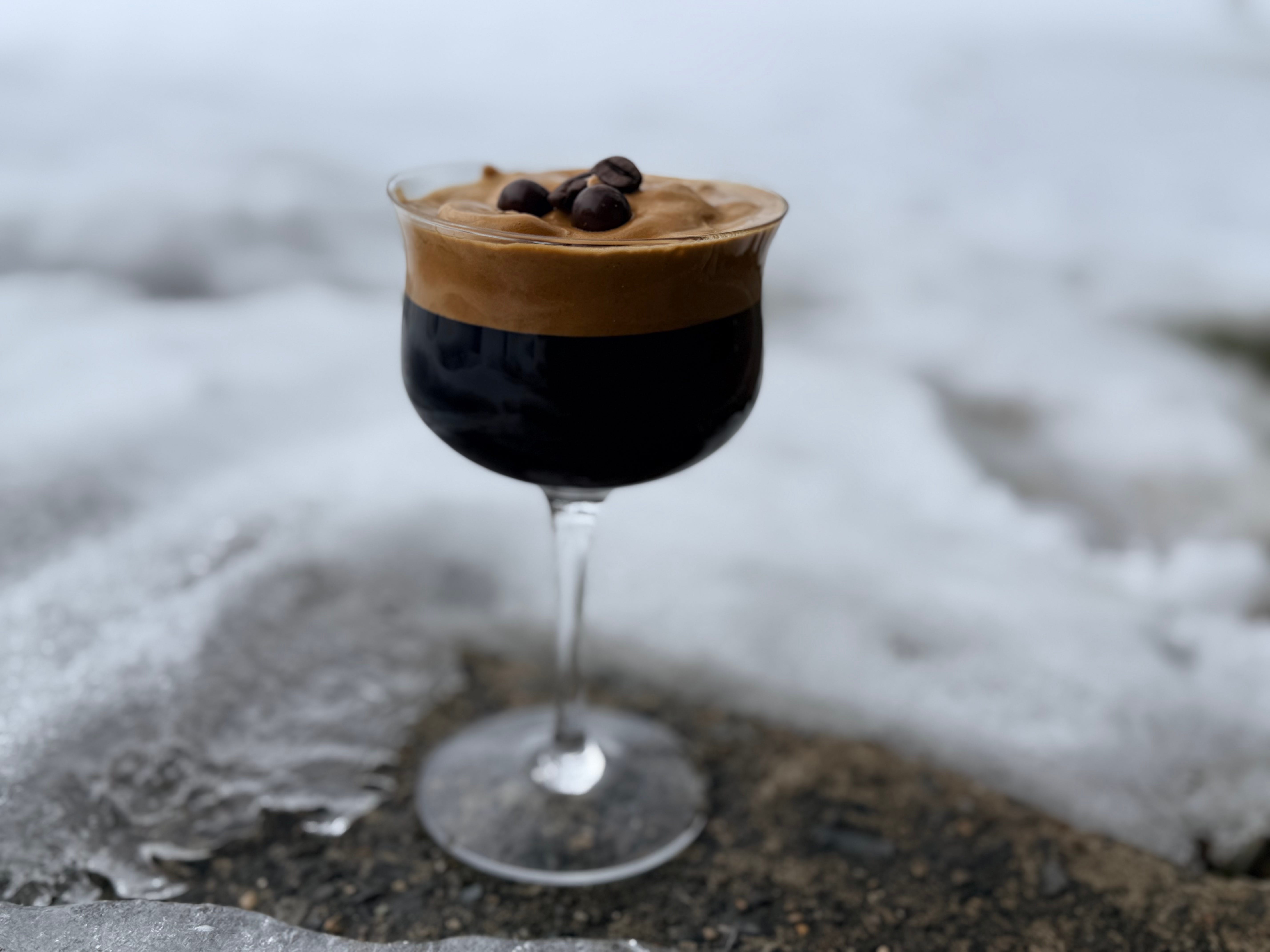
I wanted to explore a new spirit this month. January’s calendar slot said “Black Russian”—vodka and coffee liqueur, straightforward build, good contrast after December’s butter-washing complexity with the Butterbeer. Simple enough.
Then I got the chance to talk to Sam Lerman from Spyrt Worldwide last month. They sent samples for testing. Three different Ukrainian vodkas, actually—Ukrainian Freedom, Hetman, Ukrainian Spirit, and I threw in Silly Goose from Texas as a control.
That conversation changed what this cocktail needed to be.
The Renaming
When you pick Ukrainian vodka for a Black Russian, the name stops working. There’s a war happening. Calling a cocktail made with Ukrainian spirit a “Black Russian” isn’t just awkward—it’s wrong. The cognitive dissonance ruins the drink before anyone tastes it.
So this became the Kyiv Noir. Ukrainian city, film noir aesthetic, dark sophistication. The name respects the spirit’s origin and captures what the drink actually is: moody, coffee-forward, evolved past its 1949 ancestor.
Testing the Vodkas
Made half-recipe tastings—1 oz vodka, 0.5 oz Meletti Coffee Liqueur, side-by-side. Ukrainian Freedom won clearly. Smoothest finish across all candidates, clean neutral profile that let the coffee shine through, no harsh ethanol bite. Better integration with the liqueur than the others.
The vodka matters more than you’d think in a coffee cocktail. Harsh vodka creates discord with bittersweet coffee notes. Smooth vodka creates harmony. Ukrainian Freedom made the name “Kyiv” authentic, not just thematic.
But then I tasted the full 2:1 build.
The Sweetness Crisis
2 oz vodka, 1 oz Meletti. Stirred it down. Tasted it.
Too sweet. Way too sweet. And this was before any topping.
This is where most people reach for bitters to suppress sweetness, maybe add citrus to balance it out. But that’s treating symptoms. The problem was foundational.
Meletti is an amaro-style coffee liqueur. Beautiful in its own right—herbal complexity, depth, Italian craftsmanship. But it brings amaro sweetness to what should be an espresso-forward drink. The coffee flavor was buried under sugar and botanical complexity that didn’t fit the noir concept I was chasing.
Critical realization: The coffee liqueur IS the cocktail in something this simple. Two ingredients plus bitters. If the liqueur is wrong, you’re building on a flawed foundation. Bitters can’t fix that. You need a different foundation.
Complete replacement necessary.
The Coffee Liqueur Showdown
Tested four liqueurs using the same taster format—1 oz Ukrainian Freedom vodka, 0.5 oz liqueur, 2 dashes Bittercube Bolivar bitters for direct comparison:
Meletti - Too sweet (~7/10 on sweetness scale), amaro-style wrong for this application. First to get eliminated.
Copa de Oro - Even sweeter (~8/10), vanilla-heavy, budget quality showed through. The kind of liqueur that works in a crowd-pleasing frozen drink but not in a two-ingredient stirred cocktail where there’s nowhere to hide.
Kamora - Middle ground (~6/10), less sweet than Kahlúa but still sweet-forward. Better than Copa de Oro, not good enough for what I needed.
Caffè Borghetti Di Vero Caffe Espresso - Clear winner.
Why Borghetti Changed Everything
Bittersweet profile sitting around 5/10 on sweetness. Not just “less sweet”—actually bittersweet, with espresso’s natural bitter edge present and accounted for. Tastes like concentrated espresso with sugar, not vanilla candy with coffee flavor added as an afterthought.
That’s the fundamental difference: espresso-forward vs dessert-forward.
25% ABV vs the typical 20% in most coffee liqueurs. Doesn’t sound like much but it matters in stirred cocktails. Higher proof stands up better to dilution during the 30-second stir. Creates a spirit-forward rather than dessert-forward character. Better integration with 40% vodka. Maintains intensity as the ice melts.
Made from real Italian espresso using a large moka pot process. Best-selling coffee liqueur in Italy since 1860. Less syrupy texture than Mexican liqueurs. Dark chocolate notes underneath the coffee. The kind of thing Italians actually drink, not something engineered for American dessert culture.
This creates noir depth. Sweet liqueurs create dessert drinks.
The Critical Variable: You Need Less-Sweet Coffee Liqueur
This recipe only works with a less-sweet coffee liqueur. That’s not optional. If you use Kahlúa or another dessert-forward liqueur, you’ll get the same problem I had with Meletti—too sweet before you even add the foam topping, and the foam will compound the issue into something that tastes like tiramisu had a baby with a milkshake.
Recommended coffee liqueurs for this recipe (in order of preference):
Mr. Black Cold Brew Coffee Liqueur - The gold standard. Around 3/10 sweetness, 25% ABV, intense Australian-made coffee. If you can find this, use it. Best option available.
Caffè Borghetti Di Vero Caffe Espresso - What I used. Around 5/10 sweetness, 25% ABV, Italian espresso character. More available than Mr. Black in most markets.
St. George NOLA Coffee Liqueur - Around 4/10 sweetness, 25% ABV, chicory notes, California-made. Excellent if you can source it.
Tia Maria - Around 5/10 sweetness, 20% ABV, Jamaican coffee and rum base. More available than the others, less sweet than Kahlúa, works in this application.
Avoid for this recipe: Kahlúa (~7/10), Kamora (~6/10), Copa de Oro (~8/10), or any vanilla-forward liqueur. They’re fine in other contexts—White Russians, frozen drinks, coffee added to desserts. But they create a dessert drink here rather than a sophisticated noir cocktail. The structural foundation doesn’t work.
Building Complexity
With the right liqueur in place, added Bittercube Bolivar bitters—chocolate, cola nut, vanilla. Two dashes standard, can increase to 3-4 if you want more depth.
Chocolate element ties to the dark chocolate coffee bean garnish. Cola nut adds unexpected complexity that works surprisingly well with coffee—brings a subtle spice character without being identifiable as “cola.” Vanilla bridges the vodka and espresso liqueur without adding sweetness. No cinnamon—didn’t want mulling spice character that would push this toward autumn territory instead of year-round noir sophistication.
The bitters add depth without calling attention to themselves. They create sophistication rather than acting as sweetness suppression. That’s the difference—you’re building layers, not compensating for structural problems.
The Dalgona Challenge
Initial plan was dalgona coffee foam as topping. Korean whipped coffee—equal parts instant coffee, sugar, and hot water beaten to stiff peaks. Visually dramatic, Instagram-worthy, all that.
First test used brown sugar dalgona with the Meletti base. Complete disaster. Brown sugar added molasses notes on top of already too-sweet amaro liqueur. Dessert bomb. The kind of thing that sounds good in theory—”brown sugar adds depth!”—but in practice just compounds the sweetness problem.
Almost abandoned the dalgona concept entirely. Seemed like the topping was fundamentally incompatible with the drink.
Then I switched to Borghetti’s bittersweet base and tried standard dalgona with white sugar. Actually worked. The 2 tablespoons of sugar in the foam balanced against the espresso-forward liqueur instead of compounding sweetness into oblivion.
This is optimization, not compromise. The topping works because the foundation works.
Visual drama delivers: dark drink, white foam, dark chocolate coffee bean garnish. Film noir aesthetic that’s functional, not just pretty. The foam adds coffee intensity without diluting the cocktail. Texture contrast between silky stirred base and mousse-like topping. Holds structure for photography and for the actual drinking experience.
Why Instant Coffee is Essential for Dalgona (The Science Part)
You can’t make dalgona foam with brewed coffee or fresh espresso. Only instant coffee works. I tested this because I was skeptical—seems like cheaping out on ingredients, right? But there’s actual chemistry behind why instant coffee is essential, not just convenient.
Concentration is critical. Dalgona uses 1:1 instant coffee to water, creating very concentrated coffee. Regular brewed coffee is 98%+ water—too diluted for the chemistry to work. The surfactants that create foam need high concentration to form stable bubble structures.
Instant coffee is pre-brewed and dehydrated by manufacturers using either spray-dry or freeze-dry techniques. Only about 10% of the original volume remains after drying. When you rehydrate it with minimal water, you get maximum concentration. That’s why it works—you’re essentially getting 10x concentrated coffee compared to brewing fresh.
Surfactants create bubble barriers. Coffee contains proteins and polysaccharides that act like surfactants—they lower surface tension between liquid and gas. When you whip the mixture, these surfactants coat each air bubble and trap it, similar to how egg proteins work in meringue. The more concentrated the coffee, the more surfactants available to coat bubbles, the more stable the foam.
Low oil content enables foam. Fresh coffee beans and grounds contain natural oils. Those oils are great for flavor but terrible for foam—they break down the surfactant barriers and inhibit foam formation. Instant coffee, especially cheaper spray-dried versions, has much less oil remaining after processing.
Here’s the counterintuitive part: Don’t buy expensive instant coffee for dalgona. Cheaper spray-dried instant coffee foams better than premium freeze-dried because it has less oil content. The expensive stuff tastes better as instant coffee, but it actually performs worse in dalgona. Save your money and get better results.
Sugar provides structure. Sugar increases viscosity—makes the liquid thicker, more syrup-like—so water drains more slowly from the bubble walls. Also creates protective layers between bubbles that prevent them from merging and collapsing. Acts as structural glue holding everything together.
You can make sugar-free dalgona if you’re trying to reduce sweetness, but the foam will be darker in color and collapse faster. Still works, just less stable. Salt actually works almost as well as sugar for stabilization, which is fascinating from a chemistry standpoint but doesn’t taste right in a coffee cocktail.
The whole process is basically coffee meringue. Whipping introduces air into the mixture, proteins coat the bubbles creating separation that keeps them intact longer, sugar stabilizes the structure. Takes 3-5 minutes with a hand mixer, 10-15 minutes if you whisk by hand. When it’s done, the mixture should be light golden-brown and thick like peanut butter—holds stiff peaks when you lift the whisk.
Presentation and Proportions
The 8oz coupe holds a full cup at the brim. Double the recipe to fill it properly—makes enough for two drinks, but you’ll only serve one and leave the rest behind.
Stir 4 oz vodka, 2 oz coffee liqueur, and 4 dashes bitters with ice for 30 seconds. Strain enough into the chilled coupe to fill about two-thirds of the glass (roughly 5-6oz after dilution). Top with generous dalgona foam to fill the remaining third. This creates proper visual balance—substantial base, dramatic foam cap, looks intentional.
The extra cocktail base goes into your tasting glass or down the drain. You’re building for presentation, not efficiency.
Alternative if you prefer smaller presentation: Use 5-6oz coupe with the standard single recipe (2 oz vodka, 1 oz liqueur). Fills closer to two-thirds naturally with 4oz after dilution, needs only 2-3 tablespoons foam. Less dramatic but still works.
Alternative if you prefer rocks glass: 10-12oz rocks glass with large cold brew coffee ice cube. The cube takes up volume, so standard recipe plus foam achieves similar proportions. The coffee ice provides flat surface for foam and adds flavor as it melts.
What This Is and Isn’t
vs. Black Russian: Ukrainian vodka instead of Russian vodka (political statement plus quality showcase), premium espresso liqueur instead of Kahlúa’s vanilla-forward sweetness, chocolate bitters add complexity where the original is just two ingredients, dalgona foam topping brings modern craft element, dark chocolate coffee bean garnish instead of no garnish. More sophisticated, more complex, more intentional.
vs. Espresso Martini: Stirred not shaken (creates silky spirit-forward texture vs frothy coffee-forward), coffee liqueur only instead of requiring fresh espresso shot, intentional dalgona topping vs natural crema from shaking, served in coupe or rocks vs martini glass, descended from 1949 Black Russian vs 1983 invention. Different lineage, different character, different aesthetic—this is classic noir, Espresso Martini is trendy contemporary.
vs. White Russian: Optional foam topping vs heavy cream as integral ingredient, dark with white foam cap vs muddy beige throughout, foam enhances first sips vs cream stirred into milkshake texture, sophisticated craft presentation vs casual approachable drink. The White Russian is what college kids drink because it’s sweet and easy. This is what you make when you want something with coffee that doesn’t taste like dessert.
It’s evolved past its ancestor. Not trying to be a better Black Russian—trying to be something that had to move beyond that framework to become what it needed to be.
What Didn’t Work (The Honest Part)
Meletti Coffee Liqueur - Amaro-style sweetness fundamentally wrong for this application. Created dessert drink before any topping was added. Beautiful liqueur, wrong context. Eliminating it was the single most important decision in the entire development process.
Copa de Oro - Even sweeter than Meletti, vanilla dominated coffee, budget quality showed through immediately in direct comparison. The kind of thing that works if you’re making coffee liqueur cocktails for people who don’t actually like coffee.
Brown sugar dalgona - Compounded sweetness problem with Meletti base, added molasses notes that didn’t fit noir aesthetic, pushed the drink toward autumn/pumpkin spice territory when I wanted year-round sophistication. White sugar was the right call once the base was fixed.
Large ice cube logistics without coffee ice solution - Foam needs flat surface to sit on properly. Regular large ice cube creates sloped surface. Foam slides off, looks messy, doesn’t present well. Only works if you use cold brew coffee ice cube that you actually want melting into the drink.
Single recipe in 8oz glass - Doesn’t fill properly for the two-thirds base, one-third foam presentation. Solved by doubling the recipe and accepting you’ll leave some behind. Building for the photo, not efficiency.
The Recipe
Kyiv Noir
Base Cocktail:
4 oz Ukrainian Freedom vodka
2 oz Caffè Borghetti Di Vero Caffe Espresso liqueur (or other low-sweetness coffee liqueur—see recommendations above)
4 dashes Bittercube Bolivar bitters
Dalgona Coffee Foam:
1/4 cup (2 tbsp) instant coffee granules
2 tbsp granulated sugar
1/4 cup (2 tbsp) hot water
Garnish:
Dark chocolate-covered coffee bean
Method:
Make the dalgona foam first. Combine instant coffee, sugar, and hot water in mixing bowl. Beat with hand mixer until stiff peaks form—3-5 minutes with mixer, 10-15 minutes by hand if you’re feeling ambitious or don’t own a hand mixer. Mixture should be light golden-brown and thick like peanut butter when done. Can be made up to 2 days ahead and refrigerated, which is useful if you’re making multiple drinks.
Add vodka, coffee liqueur, and bitters to mixing glass with ice. Stir for 30 seconds until well-chilled. You’re looking for proper dilution and temperature, not just mixing—30 seconds is intentional.
Strain into chilled 8oz coupe glass, filling about two-thirds of the glass height (5-6oz after dilution). Reserve remaining cocktail.
Spoon generous dalgona foam onto surface of cocktail to fill the remaining third of the glass. Don’t just dump it—actually spoon it gently so it sits on top rather than mixing in. Place dark chocolate-covered coffee bean on the foam. Serve immediately.
Serves: 1 (with extra base left over)
Time: 10 minutes including foam preparation
Glass: 8oz coupe (or 10-12oz rocks glass with coffee ice cube)
Variations:
Single serve in smaller glass: Use 2 oz vodka, 1 oz liqueur, 2 dashes bitters in 5-6oz coupe
On the rocks: Use cold brew coffee ice cube for foam platform, serves in rocks glass
No foam version: Serve stirred cocktail alone for simplified presentation when you don’t want to deal with dalgona prep
Cream float: Replace dalgona with heavy cream float for Irish Coffee-style effect, simpler than dalgona but less dramatic presentation
Started this month wanting to explore Ukrainian vodka. Got samples, did testing, found the right spirit. Then discovered the coffee liqueur was more important than the vodka. Then realized the topping only works when the foundation works. Then figured out you have to build for presentation, not efficiency.
The vodka selection matters. The coffee liqueur matters more. The foam is chemistry that happens to look dramatic. The proportions create the presentation. The name honors where the spirit comes from while capturing what the drink actually is.
This isn’t a Black Russian anymore. It’s something that had to evolve past the name to become what it needed to be. That’s what testing new spirits does—takes you somewhere you weren’t expecting to go, and you build the map as you walk.