
Sangre Paloma
A blood orange Paloma for peak season

Grapefruit and bourbon is one of my favorite summertime combinations. Something about that bitterness against a sweeter spirit just makes sense to me in the heat. So the Paloma was always adjacent to something I already liked — tequila, grapefruit, cold glass — and the few I’d had were good. But they always felt like they stopped just short of something. Like the drink had more to say and the recipe got shy.
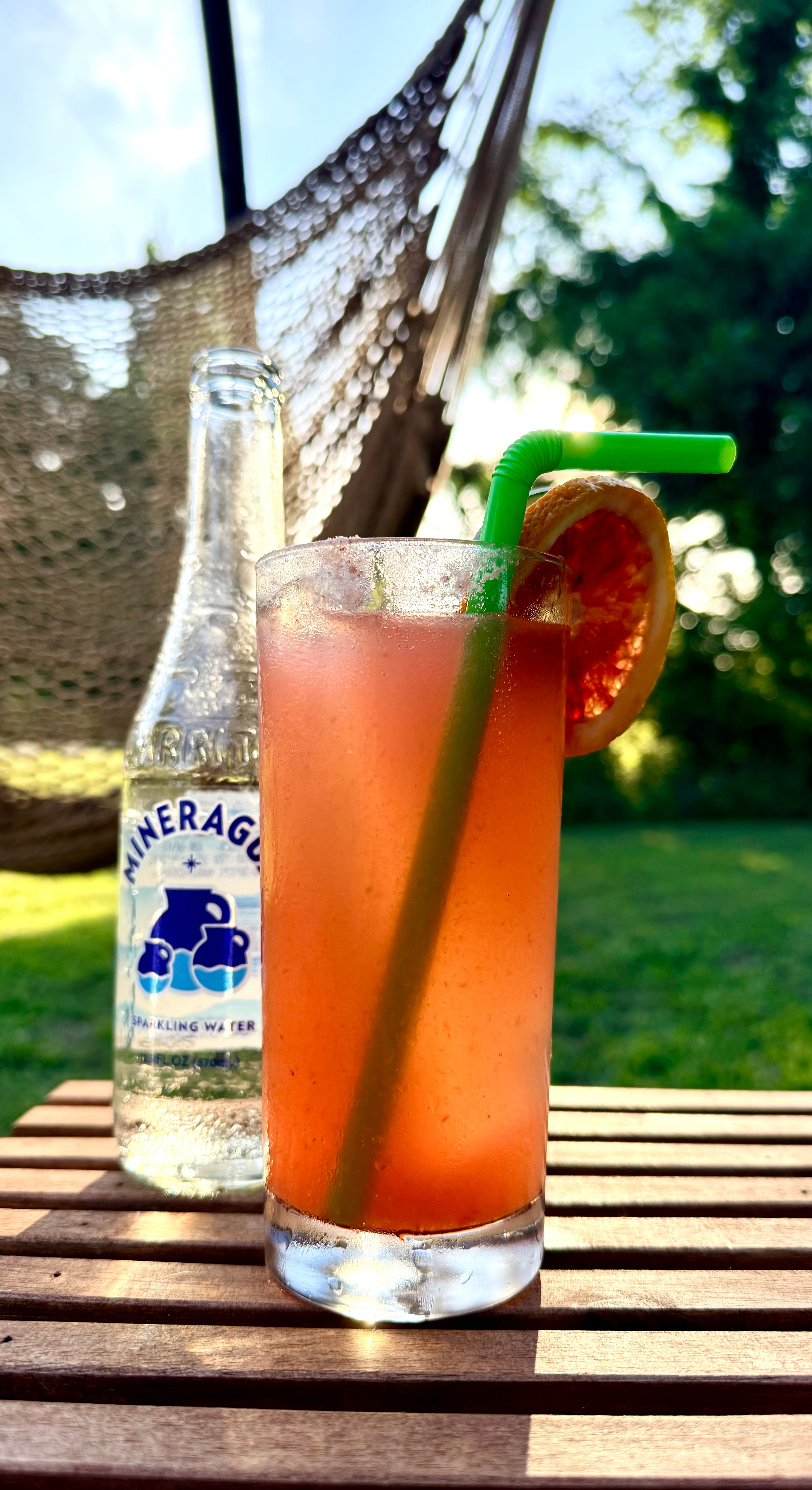
This started as an attempt to build one from scratch and find out where that extra thing was hiding. White grapefruit, blood orange, lime, dark agave, high-proof blanco. Several rounds of testing to figure out what each decision was actually doing. The blood orange is why it’s called Sangre — sangre is Spanish for blood, and that felt more honest than calling it a blood orange Paloma when the blood orange is only half the citrus story.
It’s a peak season drink. Blood orange runs December through March, and the deeply red fruit you want for this only shows up when overnight temperatures are cold enough to develop the color. Outside that window, your mileage may vary.
The Recipe
Sangre Paloma
2 oz Tapatio Blanco 110
1 oz Ocean Spray Unsweetened White Grapefruit Juice
1 oz fresh blood orange juice
1/2 oz fresh lime juice
1/4 oz Agave In The Raw dark agave nectar
3 oz Mineragua or Topo Chico
Flaky sea salt — half rim
Collins glass over ice. Pour agave into the jigger first, then measure tequila and juices through it to pull the agave clean. Top with sparkling water. One gentle stir. Half rim of flaky sea salt applied before building the drink.
The Grapefruit Decision
First variable was the grapefruit component — the foundational ingredient after tequila, and the one with the most ways to get it wrong.
Four options tested against each other with Teremana Blanco as the control: Fever-Tree Pink Grapefruit Soda, Stirrings Simple Paloma Mix with club soda, Ocean Spray Ruby Red Grapefruit Juice Drink with club soda, and Ocean Spray Unsweetened White Grapefruit Juice with club soda.
The commercial options didn’t survive the first round. Fever-Tree is sweet and convenient — both are liabilities in a scratch build. Stirrings runs 11 grams of sugar per two ounces and still doesn’t taste like enough grapefruit. Neither one lets you control the sweetness or the acid balance, which means the drink is already half-decided before you’ve touched it.
Ruby red and white grapefruit pulled ahead, but they’re not the same drink. White grapefruit is more tart, more bitter, and pure juice — no added sugar, no softening. Ruby red is labeled as a juice drink rather than pure juice, which means added sugar and less intensity. It’s not that ruby red is wrong. It’s that white grapefruit is a better foundation if you want the best version without extra pomp. The bitterness becomes a platform rather than a problem, and the pale yellow base makes the blood orange color hit harder than it would over pink.
One other finding worth noting: fresh squeezed red grapefruit was tested late in development against Ocean Spray Unsweetened White. No meaningful difference detected. The bottled product performs on par with fresh squeezed, which isn’t something you get to say often — don’t squeeze grapefruit for this recipe.
The Carbonation Problem
Both juice-based builds in the first round lacked effervescence compared to the commercial soda options. Two ounces of club soda into five-and-a-half ounces of liquid is roughly twenty-five percent of total volume, and that’s not enough for sustained fizz. Carbonation was flagged as a variable to solve later, with club soda held as the consistent baseline until that phase.
The salt discovery came out of this same period, and it was annoying in the way that obvious things are annoying once you see them. Salt added as a pinch directly into the build throughout early testing was causing nucleation — salt particles trigger CO2 release, and the fizz dissipated faster than it would without them. Moving salt to the rim fixed it, and it also reframed what the salt test was actually about. The question wasn’t just whether salt improves the flavor. It was where it lives in the build.
When carbonation was tested directly, Mineragua won over club soda. It’s a Mexican brand with more aggressive bubble structure, and there’s an authenticity argument for it in a Paloma. Topo Chico is equivalent and interchangeable. Final amount settled at three ounces — roughly forty percent of total drink volume, enough for sustained effervescence without drowning the citrus.
The Citrus Build
With white grapefruit settled, the next question was whether a secondary citrus component could add complexity and body to a drink that was tasting a little thin.
Three builds tested: pure white grapefruit control, white grapefruit and ruby red blend, white grapefruit and blood orange blend. Both tasters independently ranked the blends above the control, which settled the direction. There was disagreement on which blend — one preferred ruby red for softening the white grapefruit’s assertiveness, the other preferred blood orange for complexity. Blood orange was chosen. More distinctive, more interesting to write about, and the split gave it the edge.
Blood orange has a seasonality problem that’s worth understanding before you go buy fruit. Peak is December through March. Testing in May confirmed inconsistent results — pale, orange-red fruit read sweet and thin, without the tartness and complexity that make it worth using. The color is a direct quality signal: deeply red blood oranges are more tart and more complex because anthocyanins develop in cold overnight temperatures. When those temperatures aren’t there, neither is the flavor. If you can’t find deeply red blood oranges, ruby red grapefruit blended in is a reasonable fallback — not the same drink, but a coherent one.
Lime entered development later than it probably should have. Most scratch-built Paloma recipes include it as a brightening agent, and it was initially excluded because unsweetened white grapefruit was already delivering significant acid and bitterness — lime felt redundant. Tested at one ounce alongside blood orange as a separate component, it was too aggressive. It dominated and competed rather than complemented. The discovery came from mixing the lime build and the blood orange build together after tasting, almost by accident. The combination landed where neither could alone — lime providing brightness, blood orange providing complexity and color, and neither redundant at half the volume. Testing confirmed one-half ounce was the right call.
The Sweetener
Agave In The Raw dark agave nectar throughout testing. Dark agave over light for its more complex, earthy character — it’s a flavor contributor, not just a sweetener, and the natural affinity with tequila is hard to argue with given where both come from.
The viscosity makes conventional jigger measurement a hassle. Technique that actually solves it: agave goes into the jigger first, then tequila and juices are poured through it. The liquid pulls the agave clean and you’re not chasing residue around the inside of the jigger.
Sweetness calibrated throughout development — started at one-quarter ounce, briefly considered bumping to one-half, returned to one-quarter once the tequila proof question was resolved. Final amount balances the citrus bitterness without tipping the drink into sweet territory.
The Tequila
Teremana Blanco as the control throughout early testing — soft, approachable, clean. Teremana ran out mid-test. An honest testing reality.
Espolon Blanco tested next. Clean, citrus-forward, the reliable performer it always is.
Tapatio 110 was initially flagged as potentially too aggressive — the concern being that 110 proof would overwhelm the citrus and make the whole thing too boozy. That concern turned out to be backwards. The higher proof provided backbone and presence that stood up to the assertive citrus combination in a way the lower-proof options couldn’t. Espolon and Teremana both got lost against the bitterness of white grapefruit and the three-citrus build. Tapatio won.
The insight is about proof, not brand loyalty. Any high-proof blanco at 100 proof or above is worth trying — Tapatio 110 is the tested and preferred option, and it’s an affordable bottle for 110 proof. Most home bartenders reach for whatever blanco they have without thinking about how proof interacts with assertive citrus. This drink is a good argument for reconsidering that habit.
There’s a moment partway through a project like this where you realize you’ve moved past a variable you’re not totally sure about and you don’t want to go back. Revisiting the grapefruit decision after the citrus build was settled meant unraveling a lot of work that was already settled. So you don’t. You make a judgment call, document what you tested, and move forward. That’s not laziness — it’s how development actually goes. At some point the incremental gains stop being worth the sessions.
What I ended up with is a drink that finally has that extra thing I kept looking for. The bitterness is in the right places, the proof holds up against it, and the blood orange earns the name. Whether it would be better with different grapefruit proportions or a slightly different agave level, I genuinely don’t know. But it’s good enough that I stopped caring.
Next up is a Hemingway Daiquiri. Rum, fresh citrus, no sugar added(maybe) — Hemingway was diabetic and famously asked his bartender to make it stronger and sweeter, hold the sweet. We’ll see what that actually means to build from scratch.
The drink is named for what it contains. Make it between December and March, with the darkest blood oranges you can find.
Sangre Paloma.