
Kentucky Bramble
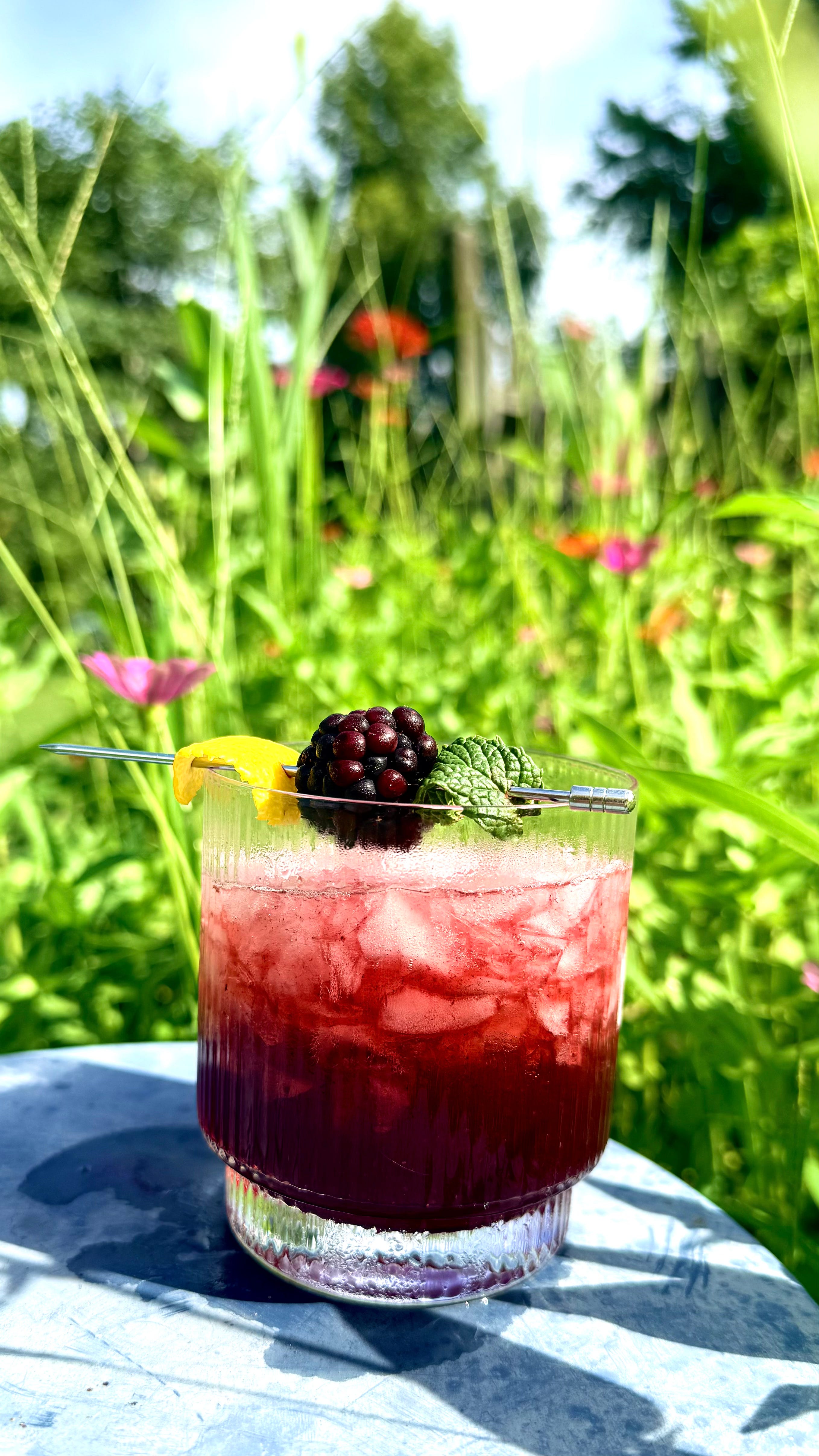
A bourbon-forward smash built around backyard produce: blackberries and mint

This one was planned around the blackberries, timed to when they’d actually ripen on the bush in the backyard rather than whenever I happened to feel like building a smash. Mint we just have, growing invasive enough that it’s never really a question of sourcing it, just how much to cut. I wanted something bourbon-forward, not a build where the whiskey is a supporting player behind a wall of fruit. Bourbon has enough backbone to stand up to blackberry if you pick the right proof and get out of its own way everywhere else, and that was the whole premise going in.
I also wanted mint in the build without the part of mint I don’t like, which is chewing on a leaf that tastes different from the leaf next to it depending on how the light hit it that week. Both the blackberries and the mint came straight from the backyard for every round of this, nothing store-bought standing in, so the syrup had to do real work to make that fresh, uneven produce behave the same way twice. So this one started as a smash and turned into as much a project about controlling variance as it was about flavor.
Thanks for reading EmbellishPod! Subscribe for free to receive new posts and support my work.
Recipe
Kentucky Bramble
2 oz Four Roses Small Batch Select
4 fresh blackberries
½ oz mint simple syrup
½ oz fresh lemon juice
Muddle the blackberries and mint simple syrup in a shaker. Add the bourbon and lemon juice(Or you can just dump it all in a shaker and give it hell). Shake with ice. Strain into a rocks glass over fresh ice.
Mint Simple Syrup
100g sugar
100g water
10–15 handfuls fresh mint leaves, stripped from the stems
Combine sugar and water over medium heat until the sugar dissolves(cloudiness should reside and be almost as clear as water), remove from heat, add the mint, and steep covered for 40 minutes. Fine strain and cool before using.
Four Roses Small Batch Select at 104 proof is the primary call for the bourbon, fruit-forward and floral enough to stay readable through the fruit and citrus without fighting either one. If you want something bolder, Old Forester 1920 brings darker fruit and a chocolate note that pairs naturally with blackberry, though it pushes the drink into a rowdier lane. Buffalo Trace at 90 proof is the budget option, and it held up fine, so don’t feel like you need to spend $50 to make this work.
Testing Log
Before I touched a shaker, I did some reading, which isn’t usually how I start these. The smash category is well-trodden enough that it was worth seeing what the consensus build looked like before burning through a season’s worth of blackberries. Bourbon, muddled fruit, citrus, sweetener, mint, sometimes a splash of soda, came up again and again, and the real divergence was in the details: which citrus, which sweetener, whether to strain, what proof bourbon, whether bitters belonged at all.
Lemon got locked almost immediately. Lime got cut on pure editorial fatigue, since I’d leaned on it across enough of the year’s development calendar that I wanted a break, not because it would have failed in the build. Grapefruit went out for a real reason, since it would have bullied the blackberry right off the glass, and yuzu and other harder-to-find citrus got ruled out too, because a big part of what I’m doing here is making sure someone in a normal grocery store can replicate this without a specialty order at least initially.
I did think about Meyer lemon for a minute. On the Irish whiskey sour I did earlier this year, Meyer’s softer acid was the right call against a gentler spirit, but bourbon doesn’t need that kind of babying. It can handle regular lemon’s sharper edge just fine, so Meyer got set aside as a possible finishing variation rather than a real contender for the base build.
Before I had simple syrup made or fresh lemons on hand, I ran an early pass against Buffalo Trace just to get a feel for the shape of the drink. That first pour used two bar spoons of caster sugar as a stand-in sweetener and grocery store lemon juice, and it was underwhelming on sweetness in a way that told me almost nothing except that two bar spoons wasn’t enough. I bumped it to four bar spoons on the next round, and the sweetness landed, but the flavor was flat, the way straight sucrose always is.
It sweetens without adding anything else, and I filed that away as an early signal that plain simple syrup probably wasn’t going to be the final answer. The one useful thing that came out of this rough pass was that Buffalo Trace stayed readable in the glass even with grocery store lemon juice and placeholder sugar working against it. If a 90 proof bourbon can hold its own in an under-built version of the drink, it’s got enough presence to work once everything else gets dialed in.
Once I had proper ingredients on hand, I got curious about whether a single product could handle citrus and sweetener together and save a step. I tried three candidates. Santa Cruz Organic Lemonade got cut fast, since it barely tasted like lemon at all and didn’t have the acid or flavor to carry the build. San Pellegrino Limonata was more promising, bringing citrus, sweetness, and carbonation all in one bottle, and for a minute I thought it might be the simplified version of this drink I could point casual readers toward.
Then I ran it head to head against standard simple syrup plus fresh lemon juice, and the fresh combination won clearly, with better acid, cleaner lemon character, and a lot more control over the final balance than a bottled product could give me. Limonata got cut from the core recipe, though it’s worth mentioning as a lazier, single-bottle option for anyone who wants to skip a step and doesn’t mind losing some precision.
This is also where the build technique settled. I started shaking the bourbon, blackberries, and mint together first, then pouring the lemon juice over the top once the drink was in the glass, on the theory that the fruit and spirit needed to integrate before citrus got introduced. It gave the same result as just adding everything to the shaker together, so lemon juice moved back into the shaker for good, since there was no reason to make the pour more complicated than it needed to be. Lemon juice volume moved around some too, starting at ¾ oz and getting pulled back to ½ oz once the sweetener testing gave me a clearer sense of balance.
With citrus and technique settled, I moved to bourbon. I’d set a target profile before running anything: vanilla and caramel forward, moderate spice, enough proof to cut through blackberry and mint without disappearing behind them. Too rye-heavy and it fights the fruit. Too soft and wheated and it vanishes.
A couple of bottles got cut on paper before they ever made it into a real comparison. Old Forester 1870 read too light for what this build needed and would have gotten lost behind the blackberry and mint before the glass was half empty. Old Forester 1924, with its Madeira cask finish, brought an uncontrolled wine character into a round that was supposed to be about bourbon, and that was too much noise to justify including it. I also kept single barrel and cask strength expressions out of this round entirely, since barrel-to-barrel variation makes for findings nobody else can replicate at home.
That left a four-way blind tasting against the locked build: Four Roses Small Batch Select, Old Forester 1920, Wild Turkey 101 8 Year, and Buffalo Trace. Four Roses won clearly, its fruit-forward, floral character running parallel to the blackberry instead of competing with it. Old Forester 1920 came in second, and its dark fruit and surprising chocolate note turned out to pair naturally with blackberry, which probably explains why it held up as well as it did despite being the most aggressive pour in the lineup.
Wild Turkey 101 8 Year landed third, refined and readable but not distinctive enough to beat the front-runners, and Buffalo Trace finished last, which isn’t the same as finishing poorly. It was perfectly functional, just outclassed by stronger company, and it remains the honest budget recommendation. I’d pay $18 for any of these four in a bar, and that’s really the framing that matters. All four work in the glass. The ranking just tells you where to spend more if you want to.
Sweetener testing came down to three syrups run against the now-locked Four Roses base: standard simple, a lemon peel steeped simple, and mint simple. Lemon peel simple was subtle, more aroma than flavor, and not strong enough to substitute for fresh lemon juice’s acid, so it works alongside the juice rather than instead of it. Standard simple syrup was functional and one-dimensional, the same flatness I’d noticed back in the caster sugar round, just with better texture.
Mint simple syrup won, and it won for a reason that surprised me. I made it with backyard mint, the same patch I used throughout testing, roughly 10 to 15 leaves stripped from the stems per 100g of sugar and 100g of water. Backyard mint runs light, about a gram per handful, noticeably lighter than what you’d buy at a grocery store, and that’s exactly the kind of inconsistency the syrup was built to erase. The syrup unified the botanical character of the drink in a way muddled mint never had, delivering the same flavor pour after pour instead of whatever that particular sprig happened to taste like. Every component in the glass stayed readable, nothing was fighting for space.
That result killed off muddled fresh mint as an ingredient too, since the syrup already carries the flavor and muddling just reintroduces the leaf-to-leaf variance the syrup was built to eliminate. I tried a bruised mint garnish, thinking it might round out the presentation, but the aroma off the glass overwhelmed the actual drinking experience, competing with the sip instead of setting it up.
With the build otherwise settled, I ran one more variant to see if a cask strength bourbon could push the drink into premium territory. 1792 Full Proof at 125 proof didn’t work. The higher ABV amplified the lemon’s acid and let the bourbon run hot enough to overtake the blackberry instead of anchoring it, which is the opposite of the job bourbon is supposed to do here.
That result confirmed something I’d been noticing since the four-way bourbon tasting: proof matters more in this drink than I expected going in. Four Roses at 104 proof sits right at the upper edge of what actually works. Push past that and the lemon and blackberry stop cooperating with the spirit.
What I Didn’t Go Back and Test
Meyer lemon never made it back into the rotation. I flagged it as a possible finishing variation early on and then never circled back once the core build was locked, mostly because regular lemon was doing exactly what I needed it to do and there wasn’t a real problem left for Meyer to solve. That’s a reasonable place to leave it rather than a gap in the testing, since chasing a refinement nobody asked for isn’t the same as chasing a fix.
I also never went looking for the exact proof ceiling between Four Roses at 104 and the cask strength failure at 125. Once 1792 Full Proof confirmed that higher proof was a liability, I didn’t feel much pull to find the precise number where things start to go wrong. Four Roses already sits where I want it, and knowing that number wouldn’t change the recommendation.
This one came together faster than most of what I’ve run through here, mostly because I’d already been thinking about the shape of the drink before the blackberries were ready and there wasn’t room for a lot of dead ends once they were. It’s bourbon-forward, blackberry-heavy, and about as replicable as a backyard-mint cocktail can be.
Next up: Jungle Bird.